
Ecommerce
How to Grow Ecommerce in Nepal in 2026: The Complete Step-by-Step Guide from an Ecommerce Expert in Nepal
 Written by Dipendra GuragainUpdated
How to grow ecommerce in Nepal in 2026: legal setup, eSewa and Khalti, delivery, SEO, AI search and ads, from an ecommerce expert in Nepal.
Article
To grow ecommerce in Nepal in 2026, register your online business, build a fast mobile-first store, accept eSewa, Khalti, Fonepay and Cash on Delivery, deliver reliably, earn customer trust, and then scale with social commerce, SEO, AI search visibility and measured ads.
I'm Dipendra Guragain, an ecommerce expert in Nepal working on ecommerce growth, SEO, AI search optimization, website development and digital marketing. This guide shows how to grow ecommerce in Nepal in 2026 step by step, using Nepali payment habits, delivery realities, the new registration rules and the search tools shoppers use today.
How to Grow Ecommerce in Nepal in 2026: The Short Answer
- Register legally. Online sellers, including those on Facebook, Instagram, TikTok and WhatsApp, fall under Nepal's e-commerce rules.
- Build a mobile-first store. Most Nepali shoppers browse on phones, so speed and a simple checkout decide sales.
- Offer local payments. Combine eSewa, Khalti, Fonepay, bank or QR payment and Cash on Delivery (COD).
- Fix delivery. Use more than one courier, pack well and send order updates.
- Build trust first. Real photos, genuine reviews, clear returns and visible business details lower buyer hesitation.
- Use social commerce. Turn Facebook, Instagram and TikTok attention into website visits, chats and repeat customers.
- Rank on Google and AI search. Write product pages and guides that answer buyer questions clearly.
- Measure profit, not likes. Track conversion rate, CAC, ROAS, COD rejection and repeat purchases.
Why Is Ecommerce Growing in Nepal in 2026?
Nepal's ecommerce market is still early-stage, but three shifts are making it easier to sell online: social platforms became sales channels, digital payments spread, and delivery got faster.
- Social commerce is leading. A Kathmandu Post report from August 2026 says individual social media sellers still dominate over centralized portals, and one platform estimates social commerce grew 30 to 40 percent a year over the past five years (Kathmandu Post).
- Digital payments are mainstream. Mobile banking and wallets such as eSewa and Khalti now move large payment volumes, according to a June 2026 report (Kathmandu Post).
- Festivals moved online. Dashain sale promotions now flood TikTok, Facebook and Instagram Reels (Ekantipur), and Tihar coverage highlights fast delivery, online payment and virtual gifts (Ekantipur).
- Physical shopping still matters. Malls stay popular during Dashain and Tihar, so online brands win by being more convenient and more trustworthy, not by ignoring offline habits (Nepal News).
Categories with strong online demand include:
- Electronics, smartphones and gadgets
- Fashion, clothing and footwear
- Beauty, skincare and wellness
- Home appliances and household products
- Daily essentials and groceries
- Cameras, drones and hobby equipment
The opportunity is not just selling products online. It is building a shopping experience that lets customers buy without visiting a store.
Step 1: Register Your Online Business in Nepal
Registration is now a growth step, not just paperwork. Nepal's e-commerce law covers all online sales, including sales made through Facebook, Instagram, TikTok and WhatsApp (Kathmandu Post). When enforcement began in July 2025, unregistered online sellers were treated as illegal, and the Department of Commerce asked digital sellers to register through its process (Asia News Network).
A practical compliance checklist:
- Register with the Department of Commerce, Supplies and Consumer Protection and keep your registration details ready to display.
- Hold the right business registration, PAN and VAT status for your activity.
- Issue proper invoices and keep sales records.
- Add business name, address, contact details, return policy and registration information to your website and social pages.
- If you import goods or sell across borders, check customs and foreign-exchange rules.
Rules and directives change, so confirm current requirements with the Department of Commerce or a qualified accountant before you scale. Compliance also builds buyer trust, which helps conversion.
Step 2: Understand the Nepali Online Shopper
Nepali online shoppers are mostly mobile-first, price-aware and cautious about unfamiliar stores. Before spending on ads, learn what drives their decisions.
- Price and quality — fair price, genuine product and an accurate description; show full specs, warranty and real photos.
- Payment — a choice between wallet, QR and COD; offer several methods and reward prepaid orders.
- Trust — proof the store is real; show reviews, contact details, registration and return policy.
- Language — English, Nepali and Romanized Nepali searches; use all three in keyword research and ad copy.
- Delivery — clear timing, safe packaging and updates; share dispatch and delivery status.
- Contact channel — Messenger, Instagram DM, WhatsApp, Viber or a phone call; offer the channel your own buyers use most.
Shoppers often compare your price with Daraz, Facebook sellers and local shops. Win on clarity, speed of reply and a smooth buying experience, not only on price.
Step 3: Build a Mobile-First Ecommerce Website
Social media creates attention, but your own website is where customers compare products, trust your brand and complete the order. It is also the asset that ranks on Google and gets cited by AI search.
A high-converting Nepali ecommerce website needs:
- Fast loading on mobile data connections
- Clear product photos and complete descriptions
- Prices shown in Nepali Rupees (NPR)
- Simple categories and search
- A short checkout with eSewa, Khalti, Fonepay and COD
- Visible shipping, return and refund policies
- Direct support through phone, WhatsApp or Messenger
For many brands the best setup is both: sell on a marketplace such as Daraz to reach existing shoppers, and run your own store to own the brand, customer data and repeat sales. Marketplace commissions and rules can change, so avoid depending on a single channel.
Step 4: Offer the Right Payment Methods in Nepal
Payment convenience directly affects conversion. Let customers pay the way they already trust.
- eSewa — best for wallet users and fast checkout; check current merchant fees and settlement time.
- Khalti — best for wallet users and developer-friendly integration; confirm fees and settlement with the provider.
- Fonepay QR — best for in-person and QR payments; match payments to orders carefully.
- Bank transfer and ConnectIPS — best for higher-value orders; needs payment-proof checking if manual.
- Cash on Delivery (COD) — best for first-time buyers and areas outside big cities; watch for fake orders, refusals and return-to-origin cost.
COD still matters because many first-time buyers want to inspect an order before paying. Relying only on COD, however, invites fake orders and rejected parcels.
A safer approach:
- Offer a small discount or free delivery for prepaid orders.
- Confirm COD orders by phone or WhatsApp before dispatch.
- Track refusals by city, product and courier, then adjust.
- For high-risk or high-value orders, ask for a partial advance.
New card options are also emerging: NIC Asia has announced acceptance of Apple Pay and Google Pay in Nepal (NepaliTelecom). Check eligibility and availability before promising them to customers.
Step 5: Improve Delivery and Logistics
A sale is not complete until the parcel arrives well. Delivery quality decides whether customers reorder and recommend you. Speed is also becoming a selling point: quick-commerce services promising delivery within minutes are gaining traction in Nepal (Kathmandu Post).
- Use more than one courier. Compare coverage, price, delivery success and return handling instead of relying on one partner.
- Promise realistic timelines. Quote delivery windows your couriers can meet consistently.
- Pack to prevent damage. Good packaging cuts complaints and refunds.
- Send status updates. Confirm the order, then notify at dispatch and delivery by SMS, call or chat.
- Plan regional coverage. As you grow, serve Pokhara, Biratnagar, Chitwan, Butwal and other cities with reliable partners.
- Track failed deliveries. Record returns by area and courier to find where money is leaking.
Step 6: Use Social Commerce to Generate Sales
Facebook, Instagram and TikTok shape the whole buying journey in Nepal, from discovery to the final message. Occasional product photos are not a strategy. Build a repeatable content system:
- Short product demo and unboxing videos
- Honest comparisons and reviews
- Customer testimonials with permission
- Before-and-after content where relevant
- Educational posts that answer pre-purchase questions
- Festival and offer campaigns for Dashain, Tihar, Teej, wedding season and Nepali New Year
Use Facebook and Instagram for awareness and targeted ads, and short vertical video for reach. The key move is to pull buyers out of the feed: send them to your website, a chat or a list you own, so sales do not depend on one platform's algorithm. Reply quickly and keep every message trackable, because slow replies lose most DM-based orders.
Step 7: Rank Your Ecommerce Store on Google With Local SEO
SEO brings buyers who are already searching, so you pay for fewer clicks over time. For a Nepali store, the work looks like this:
- Keyword research — find how buyers search in English, Nepali and Romanized Nepali, such as "buy [product] online in Nepal" and "[product] price in Nepal".
- Product pages — unique titles, specs, price in NPR, stock status, image alt text and reviews.
- Category pages — target broader buying terms and add short helpful copy.
- Technical SEO — mobile speed, clean URLs, indexing and structured data (Product, Breadcrumb, Organization).
- Internal links — link guides to products and related categories.
- Local SEO — complete Google Business Profile and keep name, address and phone consistent.
- Content — buying guides, comparisons and answers to real customer questions.
Avoid two pages competing for the same keyword. Give each search intent one clear page, and use blog guides for "how to choose" queries that product pages cannot rank for. SEO takes months, but a well-built store keeps earning traffic.
Step 8: Get Discovered in AI Search and Answer Engines
Shoppers increasingly ask AI tools such as ChatGPT and Google AI Overviews to compare products and brands. Globally, Salesforce data reported by Hostinger says AI agents influenced about 20 percent of online sales in the 2025 holiday season (Hostinger). I could not find reliable Nepal-specific AI-shopping figures yet, so treat this as an early-mover opportunity for Nepali stores rather than a measured trend.
To be understood and cited by answer engines:
- Answer first. Put the direct answer in the opening lines of each guide and product page.
- Write clear headings that match real questions, such as "Which payment methods work in Nepal?"
- Keep facts accurate and current: specs, price, stock, delivery area and policies.
- Add structured data such as Product, Organization, Article and FAQ markup, and keep pages crawlable.
- Show who is behind the content: author name, business details and contact information.
- Build a consistent brand presence across your site, Google Business Profile, social profiles and trusted directories.
- Publish original material: your own photos, test results, pricing comparisons and case notes.
The goal is not to stuff keywords. It is to be the most useful and trustworthy source for both people and search systems.
Step 9: Build Customer Trust Before Scaling Ads
Trust is one of the biggest barriers to online shopping in Nepal. Buyers want proof that the business is real, the product is authentic and the order will arrive. Fix this before you raise your ad budget.
- Genuine reviews and testimonials (never fake ones)
- Real product photos and videos, not only supplier images
- Visible phone number, address, registration and PAN or VAT details where applicable
- Transparent delivery charges
- Clear return, exchange and refund rules
- Secure payment options
- Fast, polite customer support
Fake reviews and misleading claims may lift sales for a week but damage the brand and can create legal risk. One good experience brings repeat orders and referrals.
Step 10: Run Campaigns and Measure What Matters
Once your site, payments, delivery and trust are working, scale with a mix of paid and organic channels.
- Meta Ads (Facebook and Instagram) — best for prospecting new buyers and retargeting visitors; watch cost per purchase and ROAS.
- Google Ads — best for capturing high-intent product searches; watch conversion rate and CAC.
- SEO and content — best for long-term organic traffic; watch organic orders and ranking pages.
- WhatsApp, SMS and email — best for order updates, restocks and offers; watch repeat purchase rate.
- Referral and loyalty offers — best for turning buyers into promoters; watch referral orders.
- Marketplace campaigns (such as Daraz sales) — best for reach and clearance; watch net margin after commission.
Track these numbers every week:
- Conversion rate and average order value (AOV)
- Customer acquisition cost (CAC) and return on ad spend (ROAS)
- Cart abandonment rate
- COD rejection rate and return-to-origin rate
- Repeat purchase rate
Judge success by profit and repeat customers, not by likes, followers or raw traffic.
Common Ecommerce Growth Mistakes in Nepal
Most online businesses stall because of gaps in the buying journey, not because the product is bad. Avoid these:
- Depending only on Facebook and Instagram
- Running ads without conversion tracking
- Sending paid traffic to a slow or confusing website
- Ignoring SEO and AI search visibility
- Writing thin product descriptions
- Offering only COD or only prepaid payment
- Ignoring failed COD deliveries and return costs
- Using misleading images or claims
- Forgetting customers after the first sale
- Selling without registration or invoices
- Scaling ads before fixing conversion problems
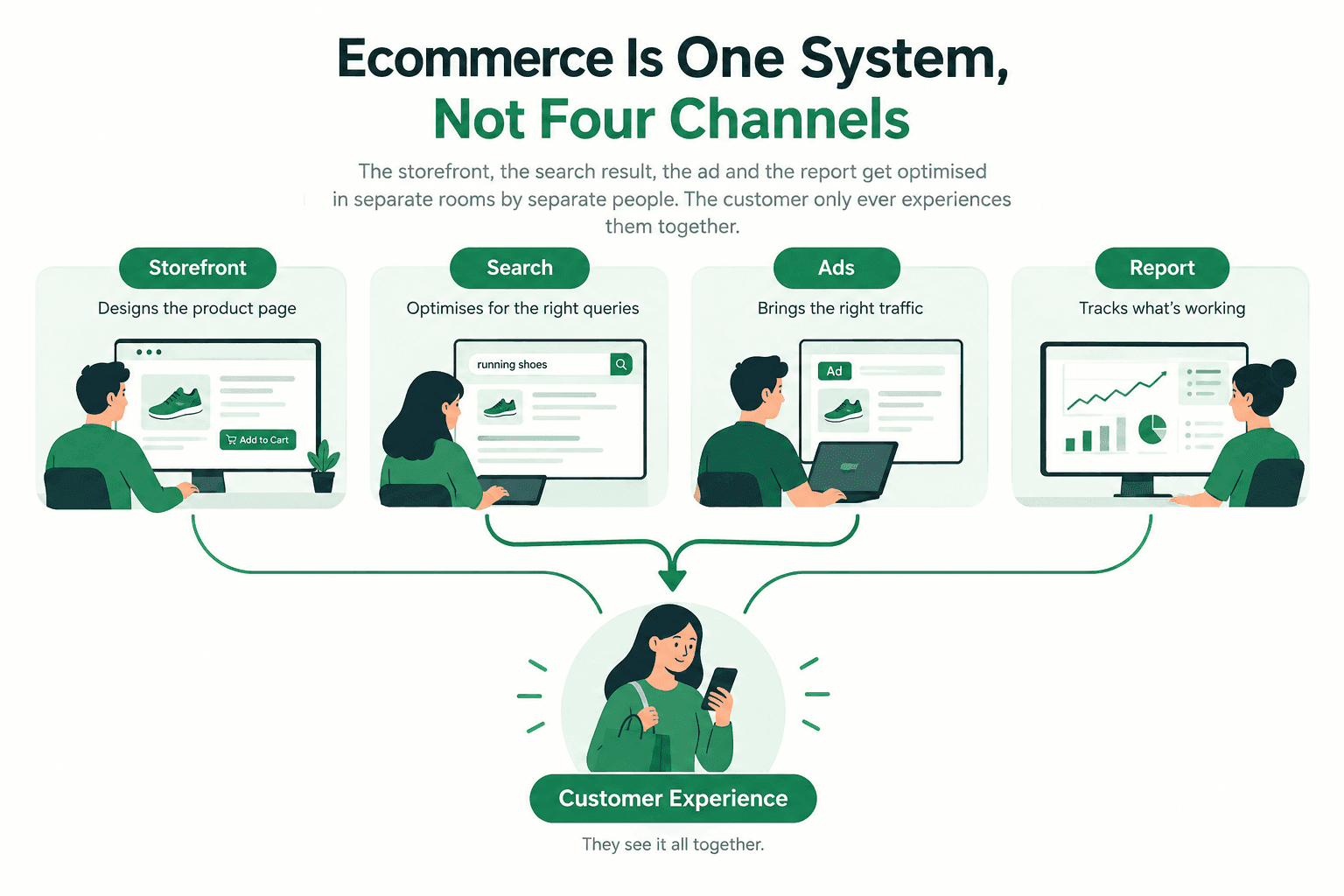
Improve the whole system rather than chasing one channel.
What Does an Ecommerce Expert in Nepal Do?
An ecommerce expert in Nepal helps online businesses plan, launch and grow stores using local payments, delivery, marketing and search knowledge. People search for this role as ecommerce expert in Nepal, e-commerce expert in Nepal and E commerce expert in Nepal, and all three mean the same thing: a specialist who connects strategy, website, SEO, ads and operations into one growth system.
A good ecommerce expert in Nepal usually covers:
- Strategy — market and competitor review, product and pricing focus, growth plan.
- Website — mobile-first store setup, speed, checkout, payment integration.
- SEO and AI search — keyword research, product and category pages, structured data, content.
- Paid ads — Meta Ads and Google Ads with conversion tracking.
- Operations — COD handling, courier choice, returns, customer support flow.
- Compliance — registration, invoicing and tax awareness.
- Reporting — weekly numbers tied to orders and profit.
How to Choose an Ecommerce Expert in Nepal
Before you hire an e-commerce expert in Nepal, ask:
- Can you show real Nepali ecommerce work and explain what you personally did?
- How do you handle COD, eSewa, Khalti and courier problems?
- What will you report each week, and how is it linked to sales?
- How do you approach SEO and AI search, not only ads?
- Do you follow the registration and consumer rules for online sellers?
Be careful with anyone who guarantees rankings, buys fake reviews or reports only likes and followers. A real expert focuses on profit, customer trust and long-term growth.
Final Thoughts: How to Grow Ecommerce in Nepal in 2026
Growing ecommerce in Nepal in 2026 means building one connected system: a registered business, a fast mobile store, trusted local payments, reliable delivery, honest social content, SEO, AI search visibility and weekly measurement. Start with trust and the buying experience, then scale traffic.
Do not chase new customers only. Improve delivery, support and repeat purchases, because that is where Nepali ecommerce profit is built. If you want a specialist to review your store, SEO or ads, an ecommerce expert in Nepal can audit the whole funnel and show you where orders are being lost.
Sources
- Kathmandu Post: Fast delivery changes the game for Nepal's online sellers (Aug 27, 2026)
- Kathmandu Post: A cashless shift in Nepal brings new ease and new risks (Jun 17, 2026)
- Kathmandu Post: Online business platforms come under ICT minimum standards (Jan 10, 2026)
- Asia News Network: Unregistered online sellers now illegal in Nepal under new e-commerce law (Jul 21, 2025)
- Ekantipur: Sale markets spreading across the digital space (Sep 28, 2026)
- Ekantipur: Tihar is a festival of e-commerce (Nov 6, 2026)
- Nepal News: Online shopping gains popularity, malls remain vital during festivals
- NepaliTelecom: NIC Asia brings Apple Pay and Google Pay acceptance to Nepal (Oct 2, 2026)
- Hostinger: Ecommerce trends 2026 (global AI-agent figure)
To grow ecommerce in Nepal in 2026, register your online business, build a fast mobile-first store, accept eSewa, Khalti, Fonepay and Cash on Delivery, deliver reliably, earn customer trust, and then scale with social commerce, SEO, AI search visibility and measured ads.
30–40%
annual growth in Nepal's social commerce over the past five years
Kathmandu Post, August 2026
20%
of online sales in the 2025 holiday season were influenced by AI agents — a global figure, since no Nepal-specific figure is published yet
Salesforce data reported by Hostinger
Questions about this article
How to grow ecommerce in Nepal?
Register your business, build a mobile-first store, accept eSewa, Khalti, Fonepay and COD, deliver reliably, build trust, then add social commerce, SEO, AI search visibility and measured ads. Fix the buying experience before increasing ad spend.
How to grow ecommerce in Nepal in 2026?
In 2026, focus on legal registration, social commerce with a website you own, prepaid-order incentives, faster delivery, local SEO and visibility in AI search. Track profit, COD rejection and repeat purchases.
How do I choose an ecommerce expert in Nepal?
Look for real Nepal-based results, knowledge of COD, local payments and couriers, SEO and AI search skills, clear weekly reporting and an honest approach with no ranking guarantees.
Is ecommerce profitable in Nepal?
It can be, when margins cover ad cost, delivery, failed COD orders and returns, and when repeat customers grow. Profit depends on the category, competition and operations.
Do Facebook, Instagram and TikTok sellers need to register in Nepal?
Nepal's e-commerce law covers online sales made through social platforms, so sellers should register and follow current Department of Commerce requirements. Confirm the latest rules before you scale.
Which payment methods should a Nepali ecommerce store offer?
Offer eSewa, Khalti, Fonepay or QR, bank transfer and COD. Multiple options suit different buyers, and prepaid discounts reduce COD risk.
Should I sell on Daraz or build my own website?
Ideally both. A marketplace gives reach, while your own website builds brand, customer data and organic traffic. Avoid depending on one channel.
How important is SEO for ecommerce in Nepal?
Very important, because it brings shoppers who are already searching for products. Optimized product pages, category pages and helpful guides can produce steady organic traffic.
How long does ecommerce growth take?
There is no fixed timeline. Ads can bring traffic quickly, while SEO, brand trust and loyalty usually take months of consistent work.
How can I get more customers for my online store?
Improve product pages and checkout, use Meta and Google Ads with tracking, publish helpful content, ask for reviews, retarget visitors and reward referrals.
Services
Work With Me On This
Ecommerce Growth Services
Ecommerce growth expert in Nepal and Kathmandu. Storefront, SEO, product pages, ads and analytics are managed as one funnel for sustainable growth.
- Shopify
- WooCommerce
- Product SEO
SEO Services
Technical SEO, ecommerce SEO, and conversion-focused growth for stores and businesses in Nepal.
- Technical SEO
- Keyword Research
- On-Page SEO
Keep Reading
Related Articles
 Ecommerce31 October 2026
How to Grow an E-commerce Business in 2026: A Complete Guide
A 6-step, profit-first plan to grow an e-commerce store in 2026 — traffic, AI search visibility, conversion, average order value and retention, with a realistic 90-day roadmap.
Read the article13 min readEcommerce4 November 202610 Best E-commerce Marketing Strategies for Small Businesses
Discover 10 e-commerce marketing strategies for small businesses that actually work in 2026 — email, SEO, content, reviews, micro-influencers, retargeting and retention — plus a 30-day action plan.
Read the article12 min read